
“We Already Are Farming” - The Story of Masello Rasebate in Lesotho
Khotso Mokitimi, Founder and Managing Director of Basotho Building Lesotho
Introducing Masello
“We start with what we have and build with what we know,” said Masello Rasebate, a 59-year-old mother of three, and a community development leader in a village called Makhoroana in Lesotho.
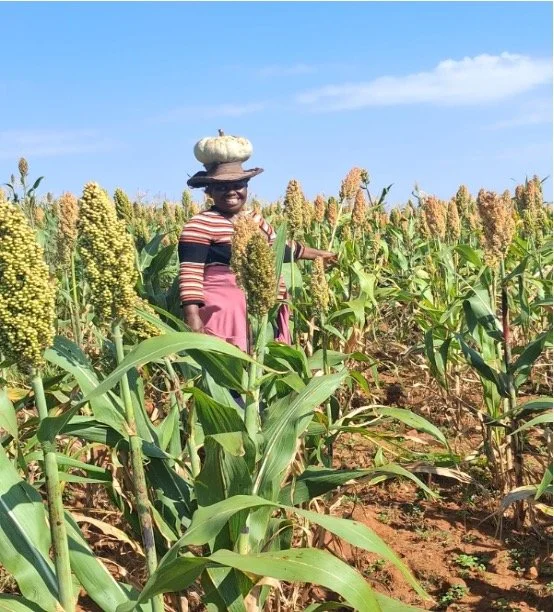
Masello Rasebate on her sorghum field, showing resilience after BBL Trainings in Makhoroana Community
How did this woman gain such wisdom and become such a catalyst for change in her community?
Four years ago, Masello attended a seminar in her village hosted by Basotho Building Lesotho, in which she was taught the principles of Community-Centred Development (CCD).
Now, wherever she goes, Masello lives the principles of CCD, and speaks the language of CCD, and reaches out to others to teach about how the cycle of poverty can be broken through the application of CCD. Four years later, she is seeing sustainable development in her community.
Masello grew up in Makhoroana where life was shaped by farming, livestock rearing, and strong communal relationships. Like many women in rural Lesotho, she witnessed poverty, unemployment, and environmental challenges that had adverse effects on the families in her village.
Many in Masello’s situation struggled with hopelessness and only waited for external assistance to provide solutions to their problems.
However, Masello was empowered by the CCD trainings and was convinced that solutions already existed within the community itself.
Masello’s Speech
Recently, Makhoroana was visited by a Member of Parliament and several development officials, in an effort to campaign for the upcoming national elections. At a traditional village gathering, called a pitso, Masello received recognition for her efforts.
However, as the visiting dignitaries spoke about their plans to help the community improve their agricultural activities and decrease levels of poverty, Masello was given an opportunity to speak.
With twenty women behind her and a handful of soil, Masello stood up and spoke with clarity: “You came here to assist us with our farming. But we were already farming. You just did not see it. We had soil, but you saw erosion. We had women, but you saw unemployed. We had a burial society, but you saw poverty.”
Those present were visibly moved by her words. They identified with the frustration that exists among many rural communities in Lesotho, which feel unheard and disrespected. More importantly, however, her words gave hope, and changed the discussion regarding poverty from a sense of dependency on external aid to one of community empowerment.
Masello’s speech at the pitso in Makhoroana Community Gathering (Pitso) reflected a powerful critique of top-down rural development approaches often introduced by politicians, government officials, and development agencies. In many rural communities, outside leaders often arrive with the assumption that local people are poor, fruitless, and helplessly dependent on external assistance.
Lessons Learned
Masello’s response challenged this false narrative by showing that communities already possessed valuable indigenous knowledge and survival tactics that often get ignored.
When Masello said, “You came here to help us farm. But we were already farming,” she highlighted the fact that the community already had agricultural practices, experiences, and traditional knowledge before outside intervention. The issue was not necessarily the absence of farming, but rather the lack of recognition and support for local efforts.
Her statement, “We had soil, but you saw erosion,” suggested that the outsiders focused only on the community’s problems (deficit-based thinking) instead of recognising its resources and potential (asset-based thinking). Development practitioners often view rural areas through the spectacles of deficiency and crisis, overlooking resilience, creativity, and local capability.
Similarly, “We had women, but you saw unemployed,” points to the undervaluation of women’s unpaid labour and community contribution. Rural women are often active in farming, caregiving, informal trade, and community leadership, yet their economic role is frequently invisible in formal development policies.
Finally, “We had a burial society, but you saw poverty,” refers to existing systems of community solidarity. Burial societies in many African communities function not only as funeral support structures but also as informal financial safety nets that promote mutual assistance, trust and social cohesion. Masello’s words therefore defended community dignity and local wisdom against development approaches that failed to appreciate grassroots realities.
Conclusion
Masello’s statements reflect rich themes of participatory development, community empowerment and sustainable local leadership. She argues that true development should begin by listening to communities, recognising existing strengths, and building on local knowledge rather than imposing external solutions. This approach affirms that community development outcomes are best achieved when they are done by community people themselves.
Masello Rasebate’s impact story demonstrates that sustainable development begins with recognising the strengths that communities already possess. She showed that rural communities are not empty spaces waiting to be rescued, but places rich in knowledge, culture, resilience and social networks.
Her story continues to inspire communities across Lesotho to value indigenous knowledge, women’s leadership, and collective action as foundations for sustainable development. We hope her story inspires the world.